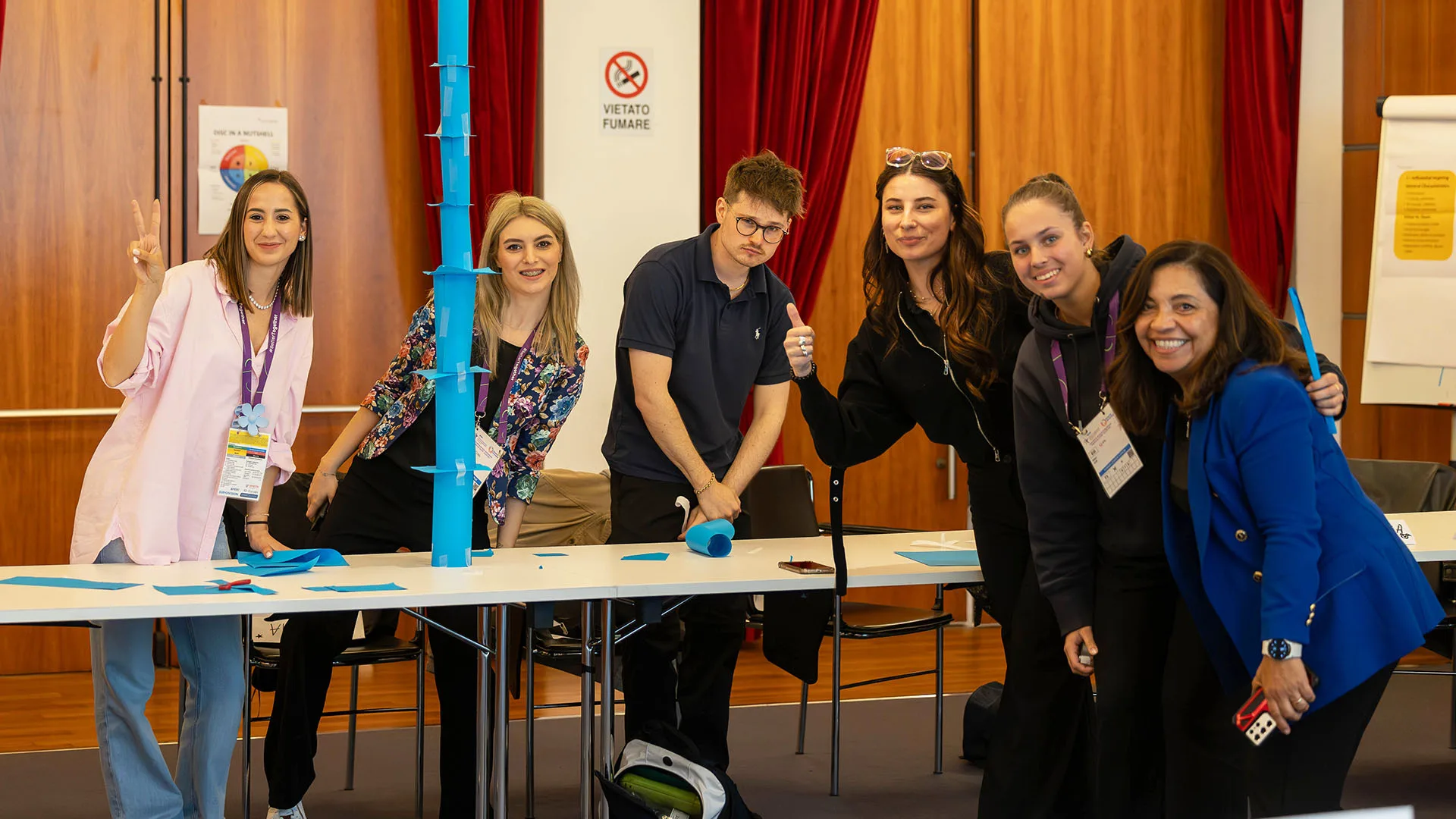
Hands-On Experience
We don’t do boring. Your teams get modern, practical learning experiences that stick — with tools they can apply right away to real challenges.

No more boring training — online or in person. Today’s leaders need dynamic, personalized learning that sticks. Micro-learning, real-time tools, and energizing delivery aren’t extras — they’re essentials.
That’s what we deliver. You and your teams get practical strategies to solve real challenges — and lead with confidence into the future.
We don’t do boring. Your teams get modern, practical learning experiences that stick — with tools they can apply right away to real challenges.
Expect dynamic activities, inspiring moments, and real connection. We keep participants 100% engaged with experiences that are fun and meaningful.
Every session is grounded in proven methodologies, 20+ years of global coaching experience, and tools designed to create real, lasting change.
Develop confident, future-ready leaders with the mindset and tools to drive strategic growth.
Empower your teams to communicate, negotiate, and influence with clarity and confidence.
Equip your leaders with the tools to stay ahead in a fast-changing, digital world.
Move from intention to action with hands-on solutions for inclusive workplaces.
Designed for mid-to-senior-level women ready to lead boldly and authentically.
One of the most important skill sets combines a technological understanding of AI and other technologies with a strong sense of human judgment and critical thinking. Leaders also need AI literacy, strategic judgment, taste, adaptability, solid communication skills, emotional intelligence, creativity, the ability to unlearn and learn quickly, and the ability to influence other people.
Clearly, AI will be taking over more tasks: analysis, comparison, content creation, and routine execution. But leaders create value by asking better, more powerful, open-ended questions, evaluating content generated by AI, and making strategic decisions even when they don’t have complete information. They must also be willing to take responsibility and accountability for the outcomes. Future-ready leadership is about knowing what to delegate to technology, what requires human judgment, and how to lead teams effectively through change and transition. Leaders need to strengthen their domain expertise because it’s no longer an information game. It’s about what makes us human and doubling down on that. AI gives everyone answers in seconds, but what it cannot provide is the taste, judgment, and decision-making of human experts, or the trust a team needs to follow a leader through uncertain times. The leaders who will win in these new times will be those who ask better questions than the machine and remain unmistakably humane, empathetic, smart, and strategic.
Are your leaders developing the skills they need as AI changes work? Talk to Gabriela Mueller about leadership development connected to your organization's priorities.
Future-ready leaders develop their competence through practice, feedback, and exposure to real, true business challenges in teams or in execution, not only by gaining more knowledge. Leadership development should strengthen these areas for future leaders: business and strategic thinking; AI and technology literacy; critical thinking and good decision-making; communication skills, influence, and collaboration; and finally, adaptability, self-awareness, and continuous learning. Those are crucial skills that make a leader future-ready and adaptable.
Organizations can also combine leadership training with coaching, practical simulations, live or online coaching, technology, customer training, feedback, and opportunities to apply the new abilities to real-world scenarios. The goal is to develop leaders who can learn quickly, make sound decisions, and lead teams effectively during change and for better performance.
Future-ready leaders are built through real-case scenarios and challenges. Therefore, give them a problem that needs a solution, a team that they need to lead, form, and help reach performance, and give them honest feedback about their growth. They will increase their self-awareness, which helps them become better leaders. In this regard, if they fail, they fail fast, early enough, and in a non-costly way through pilots. They also learn to deal with their mistakes and learn from them.
Ready to turn leadership learning into everyday practice? Explore how Gabriela Mueller can support your leaders through training, coaching, and real business challenges. early on.
In uncertain times, leaders need to provide as much clarity as possible without being “know it all” or pretending to have every answer. They need to say less and yet mean more. In uncertain times, their teams don’t really need a leader who knows and has all the answers. They need somebody who’s trustworthy, who knows what they know and accepts what they don’t know, and who acknowledges that they will communicate what happens next as soon as they can.
They also need to shorten the cycles, decide faster, and explain the reasons behind decisions. An example of this was Jacinda Ardern, the Prime Minister of New Zealand, when under stress she said it in a calm, clear, human way. Certainty is not really what happens in the job, but clarity is expected from leadership.
Strong leaders explain what is known, what is uncertain, what matters now, and what decisions will be made. They are also able to listen under stress and pressure, communicate frequently, and adjust the direction depending on the circumstances. They create enough psychological safety for their people to raise concerns, challenge assumptions, and experiment.
Leaders who adapt wisely can change their approach according to the situation while still remaining consistent with the aim, the purpose, and the values, and accountable for results. In the end, leaders cannot predict everything. People expect to have leaders who can help them understand what matters and how to move forward.
Helping your leaders navigate uncertainty?
As AI becomes more capable, skills involving human judgment, relationships and responsibility for outcomes.
The valuable human skills that are key in the era of AI are skills that involve human taste, judgment, critical thinking, relationships, and chance to add more value, and solve real problems.
Everything that AI cannot fake relies on human capabilities and skills: empathy that people actually feel. For example, or the ability to read the room, sense hesitation, increase influence among different stakeholders, and address problems. Another example is ethical decision-making when the data says one thing and the values, the context, and their expertise say another. Storytelling abilities that turn the strategy into something that people want to belong to and be part of.
Competence and knowledge may get you the seat, but being liked, trusted, and influential is what makes people want to sit next to you and work with you. Those are human skills that AI won’t replicate or replace.
There are other sills such as creativity, emotional intelligence, good communication skills in person and online, translating the communication between people, AI, and machines,. Solida human connection, collaboration in teams, curiosity, courage, adaptability, ethical decision-making, and much more. They are all key skills to continue developing.
The World Economic Forum identifies technological literacy, creative thinking, resilience, flexibility, curiosity, leadership, and social influence among those skills growing in importance. So, the opportunity is to become strong at working with AI while developing the human abilities that we need to interpret, question, filter, decide, to connect people, and to lead people. Those are skills that become more valuable as AI becomes more capable.
Influencing without authority means gaining support, building buy-in, and moving work forward when you do not control the people involved and there is no reporting line. In other words, influence means getting people to act because they want to, not because they have to.
Influence is built before you need it. That means knowing your stakeholders, understanding what they care about and what they need, speaking their language, and offering help before you ask for theirs.
To become more influential, you need to be visibly useful to people who don’t report to you and clear about the value you add. Your reputation travels faster than your title, so consistency matters: same person in every meeting, same person when nobody’s watching. That integrity builds trust and makes people willing to move.
Effective leaders understand the stakeholder landscape. Who makes the decision? Who influences it? What matters to each person? Where are the competing interests?
Five practices that help you become more influential even without authority
Understand that real Influence is not manipulation. It is the ability to create alignment and action without relying on hierarchy. It is the true power, it is not about hierarchy or seniority, it’s is influence.